Welcome to ChildFun…where Play and Learning go Hand in Hand
...where play and
learning go hand in hand!
Home » Articles » AI Coloring Books for Kids: The Step-by- Step Guide to Creating a Personalized Printed Book at Home
AI Coloring Books for Kids: The Step-by- Step Guide to Creating a Personalized Printed Book at Home
At least 15 billion images have been created with text-to-image AI tools since 2022, a figure that has risen to over 34 billion by 2025. However, less than 2% of AI images are printed in any form. Most are born and die on screens.
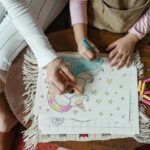
Parents finally found a real-world use for this type of technology, rather than simply being digital hoarders. They prompt an AI to create unique coloring-page outlines based on their child’s creativity. It is no longer a dream, but rather a reality, thanks to technology, and it works. The only step they are missing is turning those pages into an actual book that their kid can hold and color.
How do you turn your child’s ideas into a printed coloring book?
The process takes very little time and costs nothing for the AI generation:
Step 1: Ask your child what they wish to color. Create a list of 15 to 20 descriptions. The more insane the ideas, the better the outcome.
Step 2: Generate the image for free using any AI image generator, such as Magic Media Canvas, Bing Image Creator, or Midjourney. Some prompts that work well are simple line drawing coloring pages for kids, [child’s descriptor], black outlines, white background, no shading, etc. This yields sharp lines that are great for crayon drawing.
Step 3: Download every image in a PNG file. Put it together in a Word / Canva doc with 1 photo per page. To make it feel a little more official, put your child’s name on the cover page.
Step 4: Export the entire document as a print-quality, 300 DPI PDF. This keeps the lines clean and crisp for printing on a sheet of paper.
Step 5: Upload to HelloPrint and order personalized coloring books with saddle stitch binding. Orders from 1 to 25 copies onwards, and in just a few days, the completed books come to your door, ready for coloring.
Why does a physical book work better than a coloring app?
For children ages two to five years, it is recommended one to two hours of screen time each day. Coloring books offer kids so a lot display-free creative time that parents actively want to make more of. Digital colouring apps add a few extra minutes to the daily screen tally.
Hand-drawing stimulates brain areas involved in memory encoding three times as effectively as typing or tapping. Using a crayon and making marks on paper takes more neural pathways to produce.
Touchscreens cannot provide the levels of tactile engagement that help child development. Using crayons, touching different materials, and flipping pages teaches us how to process various senses.
What creative projects work best with custom coloring books?
A coloring book of the birthday child, a birthday party favor that takes on new meaning when everybody gets a copy. Children colour in their friends’ artwork and get to take home a little piece of the celebration.
Children can make coloring pages about their family, pets, house, and favorite foods in “About Me” books. As the kids’ interests and families change year after year, these become priceless.
Teachers can make classroom projects, and students can contribute drawings, then everyone gets a book with their classmates’ drawings (printed). It is an entire class’s creativity bound up in one volume, going home with each child. Nothing is more treasured by grandparents than a coloring book “illustrated by” a grandchild.
What makes this worth the effort?
Each child is an art director with creative whims that no stock coloring book can quite compare. Clever AI transforms such ideas into artworks. Print takes those illustrations and makes them something they can hold, color, and keep on their shelf for years to come. It offers parents exactly what they need: creative play, less screen time and something to take home.
No app or generic product can replicate the pride a child has when he/she sees their own ideas turning into a real book. They also show it to anyone who comes by. They protect it and come back to it for months. A personalized coloring book is a snapshot in time of childhood when dinosaurs wore tutus and robots required sunglasses. That moment of wild imaginativeness only lasts for so long, and a printed book captures it forever.