Welcome to ChildFun…where Play and Learning go Hand in Hand
...where play and
learning go hand in hand!
Home » Articles » STEM Rainy-Day Activities That Keep Kids Learning While Having Fun
STEM Rainy-Day Activities That Keep Kids Learning While Having Fun
STEM activities help children stay curious and engaged. Many of these activities use everyday materials, which makes them easy to set up at home. This guide shares popular, fun indoor STEM activities that keep kids learning without feeling like schoolwork.
Fun STEM Activities for Rainy Days
STEM projects give kids a chance to build, test, and experiment while gaining skills in science, technology, engineering, and math. Here are a few ideas.
Puzzle and Logic Challenge Station
Set out a mix of puzzle types such as jigsaw puzzles, tangrams, match-and-build logic cards, pattern blocks, or brain teaser pieces. Kids then choose the puzzle that interests them. Some enjoy visual puzzles that involve matching shapes or building pictures, while others gravitate toward logic puzzles that require reasoning and step-based thinking.
When they choose something more advanced, such as a Rubik’s Cube, they can follow a simple 7-step method to learn how the moves work and gradually solve it as they grow their skills.
Build a Marshmallow-Toothpick Engineering Tower
The activity introduces basic engineering ideas through building, balancing, and adjusting design choices. Younger kids often enjoy making simple cubes or small shapes. Older kids tend to explore taller builds or attempt bridges and multi-level towers. When structures wobble or lean, they rethink angles or base width. It feels playful and easy, yet it teaches problem-solving and patience.
DIY Lava Lamp Science Experiment
A clear bottle filled with oil, water, food coloring, and an effervescent tablet creates a colorful bubbling motion that draws kids in right away. The oil and water naturally separate, and the tablet produces gas bubbles that move colored droplets through the liquid layers. Younger children enjoy the visual movement and shifting colors. Older kids often become curious about density and reactions.
Paper Airplane Aerodynamics Challenge
Kids fold paper airplanes and test how far they fly, then adjust folds, weight, or wing shape to improve performance. The fun comes from trial and improvement. Younger children enjoy launching designs that glide forward. In contrast, older learners often experiment with stabilizing fins, paperclips, or sweep angles to see how flight changes. Rainy weather offers the perfect excuse to line up a hallway runway and track distance.
LEGO Coding or Engineering Builds
LEGO play can become a meaningful STEM activity when guided with simple challenges such as building a strong bridge, a working ramp, or a structure that holds weight. Children who enjoy building freely can explore shape, balance, and creative problem-solving. Older kids who enjoy tech may build mechanical components or use coding-enabled LEGO sets to program simple actions.
Balloon Static Electricity Lab
Kids create static charge by rubbing a balloon on hair, wool, or carpet, then observe how the balloon attracts paper pieces or clings to surfaces. Younger children enjoy the humor and surprise behind the reactions. Older kids begin recognizing patterns between materials and surfaces. This activity blends movement, energy, and curiosity, which works well for kids who learn through action. It also introduces early ideas about invisible forces and stored energy in a simple, familiar way.
Microscope Exploration Station
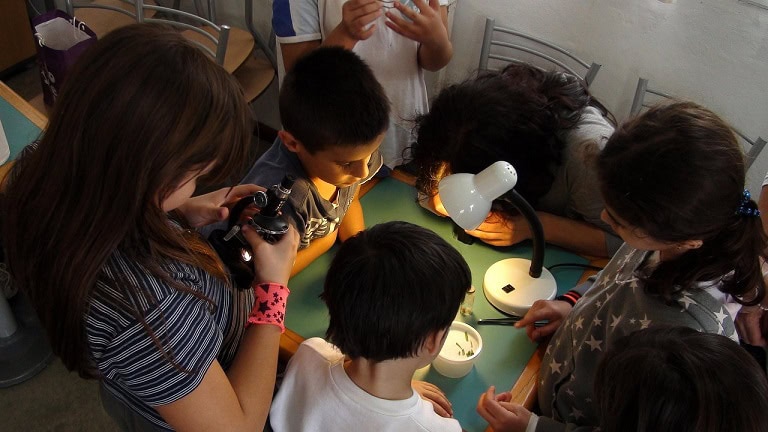
A small microscope can turn ordinary household items into fascinating discoveries. Once kids start viewing things like sugar crystals, flower petals, or fabric threads up close, the world feels bigger and more detailed. Some children stay absorbed as they compare textures and patterns, while others enjoy making simple sketches of what they see. It’s a calm, thoughtful activity that supports observation skills and curiosity, especially on a rainy day when everything feels slower and more focused.
Shoe Box Solar System Diorama
For this activity, kids start with a shoebox turned on its side to create a smallspace scene. They paint the inside dark to look like the night sky, then add stars using paint, stickers, or dots made with a cotton swab. Next, they create each planet using clay, paper balls, pom-poms, or cut-out circles of colored paper.
Once the planets are ready, they place them inside the box in the correct order. Some children glue their planets directly to the back wall, while others hang them from a string for a floating effect. This project works well because kids learn through making rather than memorizing. Some focus mainly on the art and enjoy shaping and painting each planet.
Magnet Hunt and Testing Station
To start, kids gather objects from around the home, such as paperclips, buttons, toy parts, bottle caps, craft sticks, or small kitchen tools. They place these items in a pile and test each one with a magnet. As they sort items into magnetic and non-magnetic groups, patterns begin to appear. Some children create categories or set up a labeled tray. Others enjoy turning it into a scavenger-style challenge, searching for new items to test.
Conclusion
STEM activities help build confidence because children experiment, adjust, and see progress in real time. Additionally, they encourage problem-solving and creativity, which supports both academic growth and everyday thinking. With simple materials and hands-on exploration, kids stay active, entertained, and connected to learning even when outdoor plans change.